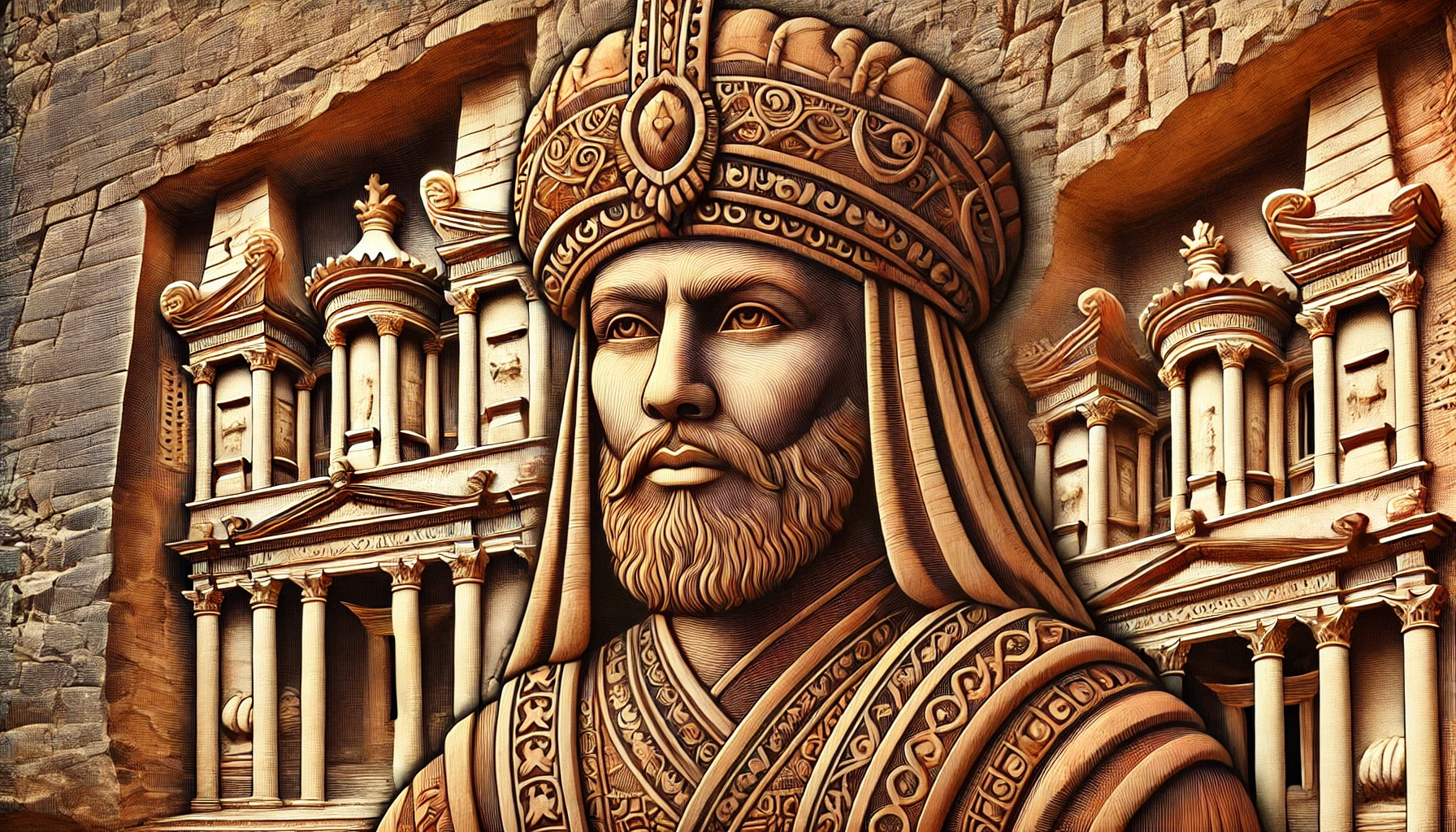
The Nabataean King Who Shaped a Kingdom
In the arid lands of the Nabataeans, where trade routes dictated the rise and fall of kings, one name stands out like an inscription chiseled into the sandstone walls of Petra: “Aretas IV Philopatris, also known as Harithath.” His reign from 9 BCE to 40 CE marked a period of unprecedented transformation, solidifying the Nabataean Kingdom’s political and economic influence in the region.
The Rise of Aretas IV
Aretas IV ascended the throne following the rule of Obodas III, at a time when Nabataean power was expanding across the Near East. The kingdom, famed for its control over key trade networks connecting Arabia, Egypt, and the Levant, found itself at the crossroads of civilizations. Aretas IV, who was born into the royal family as a descendant of Malichus I, according to Jane Taylor, who identified this from an inscription in Petra, took full advantage of this position, reshaping Petra into a flourishing capital that would become synonymous with the grandeur of Nabataean civilization.
If we are to believe Josephus, it would seem that Aretas, originally named Aeneas, came to power after an assassination of Obodas III with poison, where he took the name Aretas (Antiquities of the Jews, Book 16, Chapter 9, Section 4).
A Kingdom in Its Prime
Aretas IV presided over a period of immense economic prosperity, expanding the Nabataean Kingdom’s trading network to unprecedented levels. Under his rule, the Nabataeans established merchant ports in major cities like Alexandria, Egypt, and Puteoli in modern-day Italy. They controlled key trade routes, including the Silk Road, the Frankincense Road, and the King’s Highway, as well as vital maritime connections reaching as far as India and Sri Lanka. This expansion significantly bolstered the kingdom’s wealth and influence.
Under his rule, major developments within the Nabataean state solidified Petra’s role as a commercial and cultural powerhouse. Nabataean architecture reached new heights, blending indigenous styles with Hellenistic influences. The rock-cut façades of Petra, some of which date back to his reign, serve as a testament to his ambitions. Coins bearing his likeness further illustrate the extent of Nabataean sovereignty, emphasizing his image as a powerful and legitimate ruler. Aretas IV was prolific in minting coins, producing a wide variety in silver, bronze, and lead. His coins often bore the title ‘Aretas, king of the Nabataeans, the lover of his people.’ He had two queens: Huldu, whose profile appeared on coins until 16 AD, and Shaqilath, whose image began appearing after a few years’ gap.
The Political Landscape
Aretas IV’s reign was marked by both diplomatic maneuvering and conflict. The Nabataeans maintained a complex relationship with Rome, balancing between autonomy and imperial pressure. Josephus, the Jewish historian, records events involving Aretas IV, suggesting that his political influence extended beyond his kingdom’s borders. His connection to Judea, particularly through his daughter’s marriage to Herod Antipas, played a crucial role in the region’s power dynamics. Aretas’ daughter, Phasaelis, was married to Herod Antipas when she was around 11 or 12 years old. Upon discovering Herod’s intention to divorce her to marry Herodias, Phasaelis fled to her father. This led to a conflict where Aretas IV invaded Herod’s territory and defeated his army, an event recorded by Josephus in his Antiquities of the Jews.
Legacy in Stone and Text
Aretas IV’s contributions to Nabataean architecture were profound. Many monumental structures in Petra are attributed to his reign, including the construction of the grand theater. Excavations in 1973 revealed a temple dedicated to the Nabataean god Dhu-Shara, built by Aretas IV. Scholars also believe that the Khazneh (Treasury) was his tomb. These structures exemplify the fusion of Nabataean and Hellenistic influences, further solidifying Petra as a cultural and architectural marvel.
Archaeological evidence of Aretas IV’s rule is found not only in Petra’s architectural wonders but also in written records. His name appears in Nabataean inscriptions, coins, and even Roman accounts. These sources collectively paint a picture of a ruler who embraced both tradition and innovation, ensuring that the Nabataeans left an indelible mark on history.
The kingdom he ruled would eventually fall under Roman control, but the cultural and economic advancements he championed persisted. Today, the remnants of his reign remain etched into the landscapes of Petra, whispering tales of a time when the Nabataeans thrived under the leadership of Aretas IV, the king who shaped a kingdom.
Sources:
- “A Report on Arabia Provincia”. The Journal of Roman Studies 1971, by G. W. Bowersock
- “Aretas IV: An Archaeological Biography“. Bible Archaeology Report, by Bryan Windle
- “Nabatu – The Nabataeans Through Their Inscriptions,” by Francisco Del Rio Sánchez
- “The Religion of the Nabataeans – A Conspectus,” by John F. Healey
- “Nabataean Settlement and Self-Organized Economy in the Central Negev Crisis and Renewal,” by Tali Erickson-Gini
- “Oboda and the Nabataeans,” by Tali Erickson-Gini
- “Personal Names in the Nabataean Realm,” by Avraham Negev
- “Women and Power in Ancient Northern Arabia – Nabataea,” by Hatoon Ajwad al-Fassi
- “The Nabataean King-List Revised: Further Observations on the Second Nabataean Inscription from Tell Esh-Shuqafiya,” by Z.T. Fiema and R.N. Jones
- “Nabataean royal propaganda: a response to Herod and Augustus?” by S. Schmid
- “Jews, Idumeans, and Ancient Arabs,” by Aryeh Kasher
- “Nabataean Architecture,” by E. Netzer
- “Kings in Cuirass – Some overlooked full-length Images of Herodian and Nabataean dynasts,” by A. Kropp
- “The Hellenistic Period and the Nabataeans” by S. Schmid
- “The Onomasticon of Iudaea-Palaestina and Arabia in Greek and Latin Sources,” by L. Di Segni et al